ElevenLabs: A $22 Billion Valuation Without $300 Million in New Company Capital
The U Lab | October 24, 2026
ElevenLabs doubled its private-market valuation in less than eight months. But the more important financial distinction is where the investors' money went.
The Signal
On February 4, 2026, ElevenLabs announced a $500 million Series D funding round at an $11 billion valuation.¹ On September 30, the AI voice company announced a $300 million employee tender offer at a $22 billion valuation.²
The valuation doubled. But the two transactions had fundamentally different economic consequences. In February, investors provided new capital to ElevenLabs. In September, investors purchased existing shares through a company-organized tender, allowing employees and other eligible shareholders to realize liquidity. Reuters independently reported that the transaction did not involve a conventional capital raise for the company.³
The distinction is between financing a business and purchasing ownership from its existing shareholders. Both can establish a valuation. Only the first necessarily increases the company's cash available for operations and investment.

1. Primary Capital: Financing the Company's Growth
A primary financing transaction occurs when a company issues new shares to investors. The investors contribute money directly to the company in exchange for ownership. ElevenLabs' February Series D raised $500 million at an $11 billion valuation.¹ This provided resources to support its growth strategy, including the expansion of ElevenAgents, its enterprise conversational AI platform.
Primary capital changes the company's financial capacity. The additional cash can fund research, product development, hiring, infrastructure, acquisitions and expansion.
However, issuing new equity can also dilute existing shareholders because their percentage ownership may decline as the total share count increases. Whether and how much dilution occurs depends on the financing structure and each shareholder's participation.
Primary financing increases the company's resources while changing the ownership structure. The investment question is whether the new capital can produce sufficient additional enterprise value to justify its cost to existing shareholders.
2. Secondary Liquidity: Changing Ownership Without Funding Operations
ElevenLabs' September transaction worked differently. The company announced a $300 million employee tender offer at a valuation of $22 billion.²
In a secondary share sale, an investor purchases shares already held by someone else. The buyer receives ownership. The seller receives the purchase proceeds. The company does not receive those proceeds merely because its shares have changed hands.
This is the central distinction. ElevenLabs did not announce the tender as a new $300 million primary raise. Its stated purpose included allowing employees to participate financially in the value they had helped create.
A secondary sale of already-issued shares generally does not increase the total share count or dilute other shareholders. The ownership is transferred between investors. There can be complications when employee options must first be exercised or other equity instruments are involved, but those details do not change the basic distinction between primary issuance and secondary sale.

3. Why Would a Company Organize Employee Liquidity?
Private-company shares are not traded as freely as public-company shares. Employees may hold valuable equity but be unable to sell it until an IPO, acquisition or authorized secondary transaction. That creates a compensation problem.
A company's valuation may increase substantially while employees remain unable to convert some of their ownership into cash. A tender offer can address this constraint. It gives eligible shareholders an opportunity to sell part of their holdings to willing buyers.
This can help with recruitment and retention, particularly when experienced AI researchers and engineers have competing opportunities. The company benefits indirectly if employee liquidity strengthens its ability to retain talent. But that benefit is different from receiving new investment capital.
The immediate cash benefit belongs to the selling shareholders, not the company's operating balance sheet.
4. What Does a $22 Billion Secondary Valuation Actually Tell Us?
The tender also provided a private-market pricing signal. Institutional investors, including Wellington and T. Rowe Price, participated in a transaction priced at a $22 billion company valuation.²
That indicates the price participating investors were willing to pay under the tender's terms. It does not mean every outstanding share traded. Nor does it establish that ElevenLabs could sell the entire company for $22 billion in an acquisition.
A transaction involving a limited volume of shares can establish a reference valuation without proving the executable price for all equity. Investors must distinguish transaction-implied valuation from cash proceeds, liquidity across the entire shareholder base and ultimate exit value. These are related concepts, but they are not interchangeable.
5. What Operating Performance Supports the Repricing?
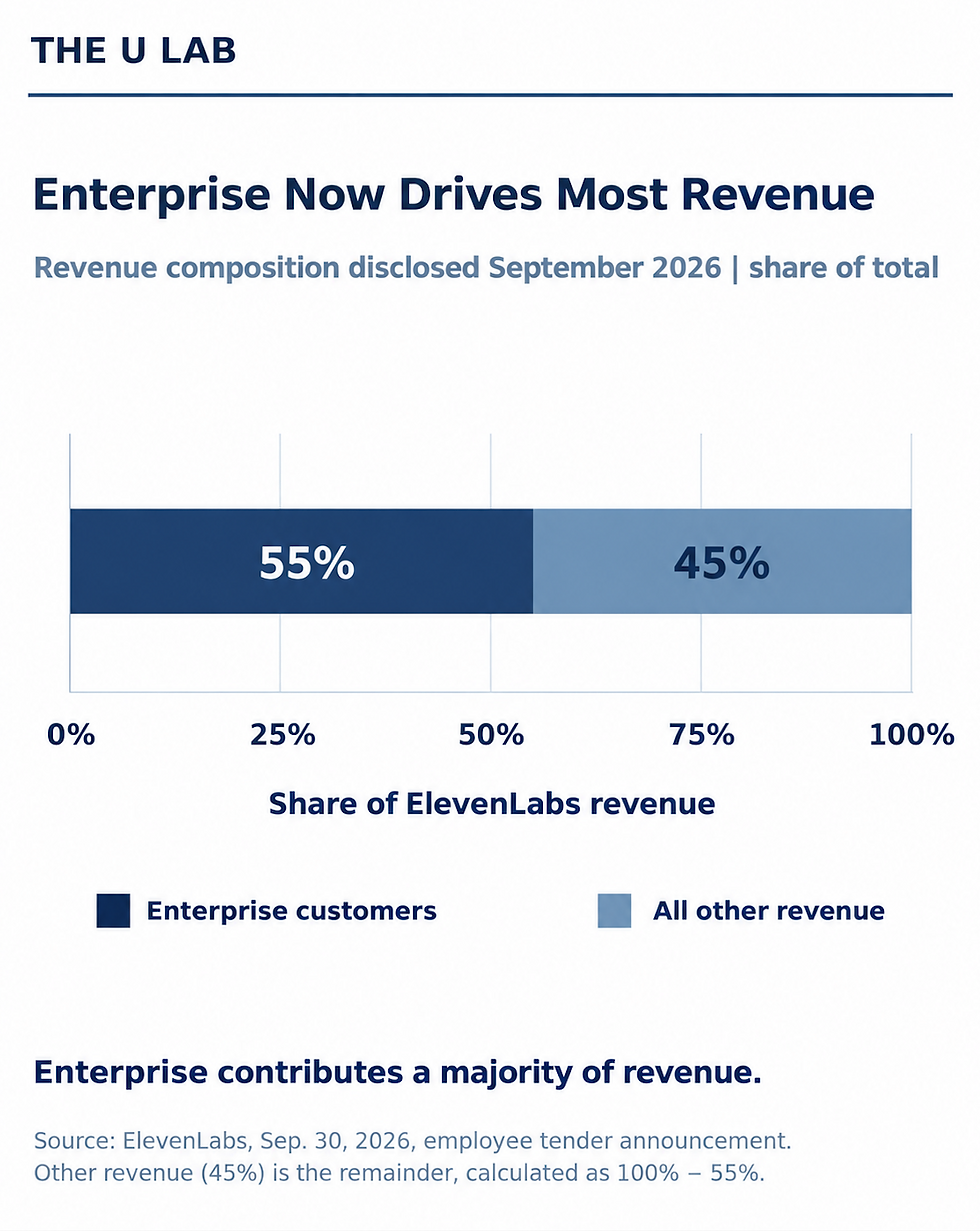
The financing distinction does not make the underlying business irrelevant. ElevenLabs reported that enterprise customers accounted for 55% of its revenue as of September 2026.² It also reported that ElevenAgents handled more than 15 million conversations each week, approximately three times February's volume.
These are operating signals that help explain investor interest. Enterprise adoption can support larger contracts, deeper integrations and potentially more durable customer relationships. But these figures do not independently establish profitability, free cash flow or customer retention. The important question is whether adoption translates into sustainable financial performance.
My Read
ElevenLabs illustrates three distinct mechanisms of value creation and value realization in venture capital.
Capital formation: A primary round provides financial resources that management can deploy to grow the company. Shareholder liquidity: A secondary sale allows existing owners to realize part of their investment value without requiring a company-wide exit. Price discovery: A transaction establishes a reference price at which participating buyers and sellers are willing to exchange ownership.
These mechanisms can occur at different times and serve different purposes. A higher valuation may improve shareholders' paper wealth. A secondary tender may convert part of that paper wealth into realized proceeds. Neither necessarily increases the company's cash available to fund future growth.
For founders, this distinction matters when choosing how to finance expansion. For employees, it matters when evaluating the realizable value of equity compensation. For venture investors, it matters when separating changes in reported portfolio value from cash distributions actually received.
The question to watch remains: As private AI companies command higher valuations, how much value is being created through operating performance, how much capital is being raised for growth, and how much is being realized through shareholder liquidity?
References
Staniszewski, M., & Dabkowski, P. (February 4, 2026). ElevenLabs raises $500M Series D at $11B valuation. ElevenLabs. https://elevenlabs.io/blog/series-d
ElevenLabs. (September 30, 2026; updated October 5, 2026). ElevenLabs valuation increases to $22 billion fueled by enterprise demand for conversational agents. https://elevenlabs.io/blog/tender-22bn
Reuters. (September 30, 2026). ElevenLabs' valuation doubles to $22 billion on surging AI voice-agent demand. https://www.reuters.com/legal/transactional/elevenlabs-valuation-doubles-22-billion-surging-ai-voice-agent-demand-2026-09-30/
Financial Times. (September 30, 2026). AI voice start-up ElevenLabs doubles valuation to $22bn. https://www.ft.com/content/08a71b38-d98c-472a-9576-e40ae2cfdf19
Disclosure: This article is for informational and educational purposes, not investment advice. Valuations are transaction-implied figures, not guarantees of liquidity or future exit proceeds. Primary financing and secondary transactions may have different terms, share classes, tax consequences and ownership effects.
If You Are New to This: Understanding from First Principles
1. What does it mean when a company is valued at $22 billion?
Imagine a company has 100 shares. Investors agree to buy some shares at $220 million per share. Multiplying that price by all 100 shares produces a $22 billion implied equity valuation.
In real companies, capitalization tables are much more complicated. They may include different share classes, employee options and other securities. The basic concept is that valuation is an estimate of the total equity value implied by a transaction price. It is not the amount of cash in the company's bank account.
2. What is a primary funding round?
Imagine you own a bakery. Your bakery needs money to open a second location. You issue 25 new shares to an investor in exchange for $50,000. The investor's money goes into your bakery's bank account. The business can spend that money on ovens, rent, employees and inventory.
That is primary capital. New shares are issued. New money enters the business.
3. What is dilution?
Suppose you originally owned all 100 shares in your bakery. You issue 25 new shares to an investor. There are now 125 shares. You still own 100 shares, but your ownership percentage has changed.
Before financing:
100 ÷ 100 = 100% ownership.
After financing:
100 ÷ 125 = 80% ownership.
Your percentage ownership has been diluted. But that does not automatically make you poorer. The company also received $50,000 in new capital. The economic question is whether that financing enables the business to create enough additional value to compensate for the reduced ownership percentage.
4. What is a secondary share sale?
Now imagine you own 100 bakery shares. Instead of issuing new shares, you sell 20 of your existing shares to another investor for $40,000. You receive the $40,000 personally. The bakery receives none of that money. There are still 100 shares in existence.
Ownership changes, but the company does not receive new financing. That is a secondary share sale.
5. Does every secondary transaction involve employees?
No. A founder may sell shares. An early venture investor may sell part of its holding to a later-stage investor. An employee may sell vested shares through an authorized tender.
All are potential secondary transactions because ownership of existing shares changes hands. An employee tender offer is a particular arrangement in which eligible employees and sometimes other shareholders can sell shares under specified terms.
6. What is shareholder liquidity?
Liquidity means the ability to convert an asset into cash. Imagine you own shares that are estimated to be worth $1 million. But the company is private, and you cannot find an authorized buyer. You have valuable ownership, but little immediate liquidity.
If a company organizes a transaction allowing you to sell $200,000 worth of your shares, you receive cash. You have converted part of your equity wealth into liquidity.
7. What is the difference between realized and unrealized value?
Suppose an investor bought shares for $100,000. A new transaction implies that those shares are worth $400,000. The investor has an unrealized gain of $300,000 if the investment is still held and measured at that valuation.
Now suppose the investor sells all the shares for $400,000. They have realized the investment proceeds. The difference is simple: Unrealized value is still represented by ownership. Realized proceeds are received through a sale or other distribution. Taxes, fees and contractual terms can affect what the investor ultimately keeps.
8. Why would investors buy secondary shares?
Different investors have different objectives. An employee may want cash to purchase a home or diversify their finances. An early investor may want to return capital to its own fund investors. A new institutional investor may believe the company will become substantially more valuable.
Therefore, one shareholder may rationally sell at a price another investor is willing to pay. The transaction brings together a seller seeking liquidity and a buyer seeking future returns.
9. Why does secondary liquidity matter to venture capital funds?
Venture funds often hold investments for many years. Their portfolio companies may grow substantially in value without producing cash proceeds. A secondary sale can allow the fund to realize part of its investment before the company's ultimate exit.
That matters because limited partners ultimately receive distributions, not simply valuation marks in portfolio reports. However, a fund selling only part of its ownership may still retain substantial unrealized exposure.
10. What does the 55% enterprise revenue figure tell us?
ElevenLabs reported that enterprise customers generated 55% of revenue. Imagine the company earns $100 in total revenue. Approximately $55 would come from enterprise customers, and $45 from other customers or revenue categories.
That provides information about its revenue composition. It does not tell us the company's profit margin, the profitability of enterprise customers or how long those customers will remain. Those require additional financial and operating data.
11. Can valuation rise without a new fundraising round?
Yes. Imagine an investor purchased shares when a company was valued at $100 million. Two years later, buyers acquire existing shares at a price implying a $300 million company valuation.
The company may not have received any new capital through that secondary transaction. Nevertheless, the transaction establishes a new reference price for the equity. Valuation can change because the price investors are willing to pay changes, even when the company's operating cash balance does not increase.
12. What is the central investment lesson?
Whenever you read that a startup has reached a new valuation, ask three separate questions:
Did the company issue new shares and receive capital?
Did existing shareholders sell shares and receive liquidity?
What operating evidence supports the transaction price?
The answers tell you whether the announcement concerns business financing, shareholder monetization, price discovery or some combination of these.
The central lesson: Valuation is a price. Primary financing provides company capital. Secondary sales provide shareholder liquidity. They are not the same economic event.


Comments